Supporting researchers from manuscript preparation to journal submission, peer review and publication.

OUR SERVICES
Professional Research & Publication Support
From research to recognition, we support you at every step.
Academic Editing and Proofreading Services for Research Papers
Prepare your research for clear, professional communication with academic editing and proofreading. We help researchers, academics, and students improve grammar, readability, sentence flow, consistency, and presentation while preserving the meaning, data, and original ideas in their work.










Academic Editing & Proofreading Across Research Fields
Our editing and proofreading service helps researchers, academics, postgraduate students, and research teams improve the clarity, consistency, and readability of their academic writing. We review manuscripts, theses, dissertations, reports, and scholarly documents while following the journal or institutional guidelines you provide.
How the Process Works
Share Your Draft and Requirements
Send your document and provide the word count, subject area, target journal or institution, preferred language variant, reference style, and deadline.
Editing or Proofreading
The document is reviewed according to the agreed editing level. Work may include correcting language errors, improving clarity and flow, standardising terminology, and flagging passages that need author clarification.
Review the Edited File
Receive the revised document in the agreed format. Where included in the scope, changes may be tracked and queries or comments supplied so you can review the edits and confirm the accuracy of technical content.
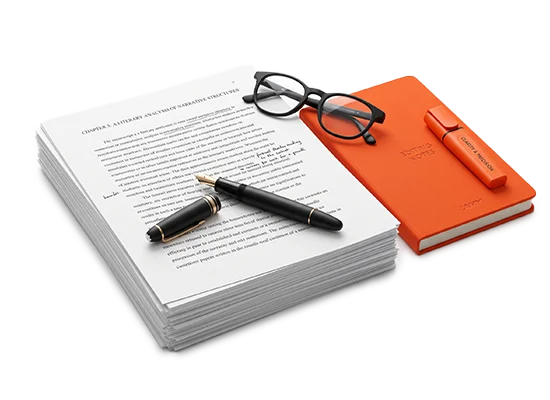
Make Your Academic Writing Clear, Consistent, and Professional
A strong research paper needs to communicate its methods, findings, and conclusions accurately. Language issues, inconsistent terminology, unclear sentences, and formatting differences can distract readers from the research itself. Our editing and proofreading support focuses on improving the presentation of your work while keeping your intended meaning and research claims intact. The appropriate level of editing depends on the document. Proofreading focuses on surface-level errors; language editing improves clarity and sentence flow; structural editing may address organisation and transitions within the agreed scope.
Our Editing and Proofreading Services
Academic Proofreading
Check spelling, punctuation, grammar, typographical errors, and basic consistency in a near-final document.
Research Paper and Manuscript Editing
Improve sentence structure, readability, academic tone, word choice, and transitions while preserving the author’s meaning and research findings.
Thesis and Dissertation Editing
Review academic chapters for language clarity, consistent terminology, grammar, and presentation according to the agreed scope and institutional instructions.
Scientific and Technical Editing
Edit research writing in relevant subject areas, taking care with technical terminology, abbreviations, units, and discipline-specific language.
Structure and Clarity Review
Identify unclear passages, repetition, abrupt transitions, and organisational issues. Suggestions are provided without inventing research content or unsupported conclusions.
Formatting and Reference Consistency
Check headings, tables, figure captions, in-text citations, and reference-list formatting against the style guide or journal instructions supplied by the author.

Why Choose Our Editing Support?
Meaning-preserving edits: Improve the language without changing the author’s findings, data, or intended argument.
Academic writing focus: Use a formal, readable style suitable for scholarly and research documents.
Consistency checks: Help standardise terminology, abbreviations, spelling conventions, headings, and formatting.
Scope tailored to your draft: Choose proofreading, language editing, or a broader review based on the document’s needs.
Author remains in control: Review changes and resolve queries about technical meaning before finalising the document.
Journal-guideline awareness: Use the target journal’s supplied instructions to guide formatting and style checks where requested.
Documents We Can Review. Academic Content. Research Support.
Review journal manuscripts, research articles, theses, dissertations, and research proposals for clarity and consistency.
Research and academic documentsReview conference papers, abstracts, posters, literature reviews, and research reports with attention to structure and presentation.
Conference and research materialsReview grant proposals, academic project documents, book chapters, scholarly reports, cover letters, and author biographies.
Publication-related documentsFrequently Asked Questions
Proofreading usually focuses on surface-level issues such as spelling, punctuation, grammar, and typographical errors. Editing can go further by improving clarity, sentence flow, terminology, consistency, and—if included—document structure.
Yes, we can review a manuscript for language clarity, academic tone, consistency, and agreed formatting requirements. The author remains responsible for research accuracy and meeting the journal’s submission rules.
We can review theses, dissertations, and selected chapters. Please share the word count, subject area, institutional requirements, and deadline so the scope can be confirmed.
The purpose of language editing is to preserve your intended meaning. If a sentence is ambiguous or a technical claim needs clarification, it should be flagged for your review rather than changed based on an assumption.
We can check citation and reference consistency against the style guide or journal instructions supplied, within the agreed scope. Authors should verify that all source details are accurate and complete.
Pricing depends on word count, document condition, subject complexity, editing depth, formatting requirements, and deadline. Share these details to request a quote.
Turnaround depends on document length, complexity, and selected service level. A delivery estimate should be confirmed after reviewing the file and requirements.
No. Editing can improve language clarity and presentation, but editorial decisions depend on research quality, journal scope, peer review, and other factors outside the editing service.
Tracked changes or an edited copy with comments can be provided if included in the agreed service scope. Confirm the preferred delivery format when requesting a quote.
Yes, where the requirements are supplied and fall within the agreed scope. Please share the journal name or author guidelines before work begins.
Get Your Manuscript Ready for Review
Share your draft, word count, subject area, target journal or institution, and deadline. We’ll review the
requirements and confirm an appropriate editing or proofreading scope.