Supporting researchers from manuscript preparation to journal submission, peer review and publication.

OUR SERVICES
Professional Research & Publication Support
From research to recognition, we support you at every step.
H-Index and Research Impact Support for Researchers
Understand and present your scholarly impact with structured H-index and research impact support. We help researchers and academics organise publication records, review citation data, identify profile inconsistencies, and prepare clear summaries of their research contributions using verifiable information from relevant scholarly databases.










Research Impact Support Across Academic Fields
Our research impact support helps researchers, academics, and research teams review, organise, and communicate publication and citation information. We assist with research summaries, academic CVs, promotion materials, grant documents, author records, and evidence portfolios using the publication and citation information you provide.
How the Process Works
Profile and Goal Review
Share your public author profile, publication list, research field, and intended use for the review. We confirm which data sources and reporting requirements are relevant to your request.
Publication and Citation Data Check
We review available records for possible author-profile splits, duplicate entries, missing metadata, title variations, and citation-count differences. Any corrections must follow the relevant database’s official processes and eligibility rules.
Research Impact Summary
Receive an organised summary of the reviewed metrics, relevant profile observations, and practical next steps. We explain data sources and limitations so the figures can be interpreted in context.
Make Your Research Record Easier to Understand
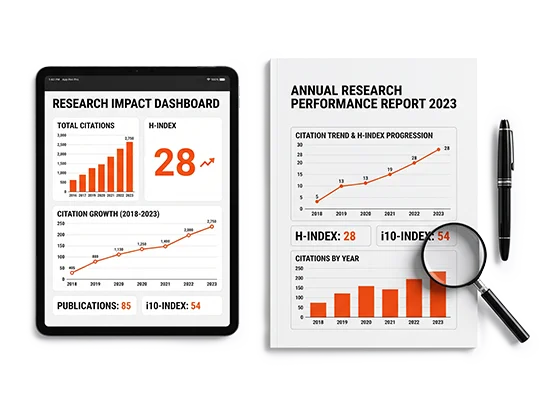
Research impact can be described through several indicators, including publication output, citation counts, the h-index, and field-specific measures. These indicators vary across databases because their coverage, author matching, update schedules, and calculation methods differ. Our service helps you review the available records, understand the metrics, and present your scholarly activity accurately. We do not manufacture citations, manipulate metrics, guarantee a particular h-index, or promise academic promotion or funding outcomes. Any correction or profile change depends on the relevant database’s rules and review process.
Our H-Index and Research Impact Services
H-Index Review and Explanation
Review the h-index shown in the database or profile you specify and explain how it relates to the publication and citation records available there. The h-index should always be reported with its source and review date.
Citation Record Review
Check available citation records for possible metadata issues, missing links, duplicates, or differences between platforms. Database-specific corrections must be requested through the appropriate official channel.
Author Profile and Publication List Review
Help identify possible profile fragmentation caused by name variants, affiliation changes, or inconsistent publication metadata, then outline appropriate correction steps.
Research Impact Summary Preparation
Prepare a clear summary of publication output, citation indicators, research themes, and documented contributions for academic or professional use, based on verified information.
Research CV and Academic Profile Support
Improve the presentation of publication lists, research interests, selected contributions, and accurately sourced metrics in a CV, biography, or academic profile.
Research Visibility Recommendations
Offer ethical suggestions for making genuine research easier to discover, such as complete metadata, consistent author identifiers, accessible abstracts, accurate keywords, and appropriate repository or profile updates.

Why Choose Our Research Impact Support?
Data-based review: Use identifiable scholarly records and explain where each metric comes from.
Transparent methodology: Distinguish between database metrics instead of combining figures that use different coverage or calculation methods.
Accurate reporting: Include the database name and review date when presenting h-index or citation data.
Researcher-focused presentation: Help communicate research contributions clearly without overstating what a metric proves.
Ethical visibility practices: Focus on legitimate discoverability and record accuracy, not artificial citation activity.
Practical next steps: Provide a clear summary of observations and any official profile-maintenance actions that may be relevant.
Information to Share. Clear Details. Focused Review.
Share your public author profile link or researcher identifier, such as ORCID, together with your publication list or CV.
Author and research profileProvide the database or platform you want reviewed, along with your research field and the purpose of the review.
Review scopeIdentify records you believe are missing, duplicated, or incorrectly attributed, and share any required reporting format or deadline.
Records and requirementsFrequently Asked Questions
The h-index is a citation metric that combines publication output and citation counts. A researcher has an h-index of h when h publications have each received at least h citations, subject to the data source’s records and calculation method.
No. Databases cover different publications and citations, match author records differently, and update at different times. Always identify the source database and date when reporting an h-index.
No. Citation metrics depend on genuine scholarly citations and database coverage. We can help review records and suggest ethical visibility improvements, but we cannot guarantee an increase or a specific metric.
We can help identify potentially missing or incorrectly linked records and explain the relevant official correction process. Citations must be genuine and recorded according to the database’s rules; we do not create artificial citations.
We can help identify possible inconsistencies and outline steps for requesting corrections. Actual changes are subject to the platform’s verification process and policies.
Citations are one indicator of how scholarly work is referenced. Research impact can also include contributions to methods, practice, policy, teaching, technology, or society. Citation metrics alone do not capture every type of impact.
A well-organised summary may help present your record, but you should follow the specific institution or funder’s instructions and verify every figure before submission. No particular outcome is guaranteed.
The sources depend on the information available and your project requirements. Tell us which platform you use—for example, Scopus, Web of Science, Google Scholar, or an institutional profile—and we will confirm the scope before starting.
Timing depends on the number of records, data availability, and the depth of review. We can confirm an estimate after seeing the profile link and requirements.
No. We do not create, purchase, exchange, or arrange artificial citations. Our work focuses on accurate records, transparent metric interpretation, and legitimate research discoverability.
Get a Clearer View of Your Research Impact
Share your author profile, publication list, and the metrics or records you want to review. We’ll confirm the scope
and help you organise the available information into a clear, evidence-based summary.